


Access the exact BLUEPRINT we are using to save one of our clients over $105,000 in taxes in just one year.
By submitting this form, I agree to receive occasional marketing email and SMS messages from Keystone CPA, Inc. Data rates may apply.
Text HELP to +1 (714-251-6861) for assistance or reply STOP to unsubscribe at any time.
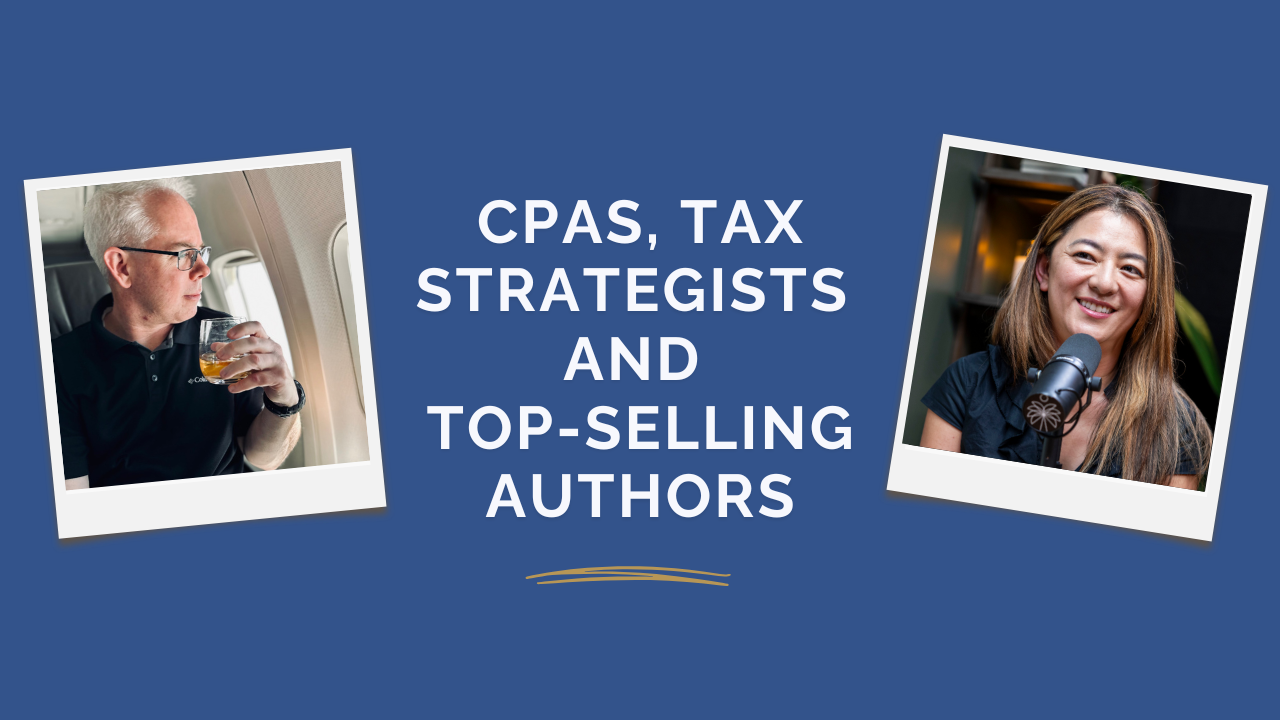
HELPING PEOPLE NATIONWIDE TO SAVE ON TAXES
and Build Wealth
Take the free 2-minute self-assessment to get your tax score and a personalized report showing potential tax risks, missed opportunities, and where you could keep more of what you earn.


Whether you are a new or seasoned investor or business owner, we have a tax saving solution for your needs.
Learn MoreQuestions, answered
What people ask us most about tax planning and working with Keystone CPA.
How it works Process, pricing, and what to expect +
What is the difference between tax preparation and tax planning? +
Tax preparation is the process of filing a return for a year that has already ended. Tax planning happens before the year closes and involves structuring income, entities, deductions, and investments to reduce the amount owed. By the time a return is prepared, most opportunities to lower the bill have already passed.
How does working with Keystone CPA begin? +
To determine if we are the right fit for you, the first step is a one-on-one private discovery call. The call is designed to learn more about your current finances and your needs, and to help determine whether we would be the right fit for you. Schedule your discovery call here.
Once onboarded as a client, every engagement starts with a consultation to review the client's income, business, entities, investments, and real estate holdings. From there, Keystone CPA builds a written tax plan with specific strategies and implementation steps.
How much does it cost to work with Keystone CPA? +
Keystone CPA bills on a flat fee basis rather than hourly. Clients know the cost before work begins, and there is no guesswork. Our tax planning fees can range from as little as $20k up to $55k.
Does Keystone CPA also prepare and file tax returns? +
Yes. Keystone CPA prepares individual, business, and multi-state returns for its planning clients, so the strategy and the filing stay connected. This service is available only to our tax planning clients and carries a separate fee.
What if I am not in a financial position to invest in real estate? +
Real estate is not the only means to reduce tax. If your investment goals do not include real estate, our tax strategist will focus on strategies outside of real estate to meet your tax saving needs.
About Keystone CPA Who we are and who we work with +
Who is Keystone CPA? +
Keystone CPA, Inc. is a CPA firm specializing in tax planning for real estate investors, business owners, and high-income earners. Founded by Amanda Han and Matt MacFarland, the firm works with clients nationwide and focuses on proactive strategy rather than year-end tax preparation alone.
Who are Amanda Han and Matt MacFarland? +
Amanda Han and Matt MacFarland are CPAs and the founders of Keystone CPA, Inc. They are co-authors of the top-selling book Tax Strategies for the Savvy Real Estate Investor, published by BiggerPockets, and have been featured in Forbes Finance Council, Money Magazine, CNBC, and Talks at Google.
Do I work directly with Amanda and Matt? +
Amanda and Matt personally train our entire strategy team and provide input on client strategies where appropriate. You'll also have direct access to them during our twice-monthly group strategy sessions. Private one-on-one access to Amanda and Matt is reserved for select service levels.
Does Keystone CPA work with clients outside California? +
Yes. Keystone CPA is based in California and works with clients across all 50 states. Federal tax law applies nationwide, and the firm handles multi-state filings for investors who own property in more than one state.
How is Keystone CPA different from a typical CPA firm? +
Most accounting firms focus on tax preparation, recording what already happened. Keystone CPA leads with tax planning, which means identifying strategies during the year while there is still time to act on them. The firm specializes in real estate, so strategies like cost segregation, entity structuring, and passive loss planning are part of our core expertise.
Common tax questions Real estate strategies people ask about most +
Can real estate losses offset W-2 income? +
Sometimes. Rental losses are generally passive and can only offset passive income. Two main exceptions exist: qualifying for Real Estate Professional Status, or owning a short-term rental where the average guest stay is seven days or less and the owner materially participates. There is also a limited allowance for active participants that phases out at higher income levels.
What is Real Estate Professional Status? +
Real Estate Professional Status is an IRS designation that allows rental losses to offset non-passive income such as wages. It requires spending more than 750 hours per year in real property trades or businesses, and more than half of all personal service time in those activities. The taxpayer must also materially participate in the rental activity itself. Contemporaneous time logs are essential if the position is examined.
What is the short-term rental tax strategy? +
When the average guest stay at a rental property is seven days or less, the activity is not automatically treated as a rental under the passive activity rules. If the owner materially participates, losses from that property may offset other income including W-2 wages. This is why short-term rentals are frequently paired with cost segregation studies.
What is a cost segregation study and is it worth the cost? +
A cost segregation study identifies components of a building — fixtures, flooring, land improvements — that can be depreciated over 5, 7, or 15 years instead of 27.5 or 39. This front-loads depreciation deductions into the early years of ownership. Studies generally make sense on properties above a few hundred thousand dollars in basis, but the benefit depends on whether the owner can actually use the resulting losses.
Do I need an LLC for my rental property? +
An LLC provides liability protection but does not by itself reduce federal income tax. A single-member LLC is disregarded for tax purposes, meaning the income is reported the same way it would be without the LLC. Entity structure affects taxes mainly for operating businesses, where an S-corporation election can reduce self-employment tax.
When should I start tax planning for the year? +
Earlier is better. Most strategies require action before December 31, and some, such as retirement plan setup or entity elections, have deadlines earlier in the year.
Still have questions?
Book a Free Discovery Call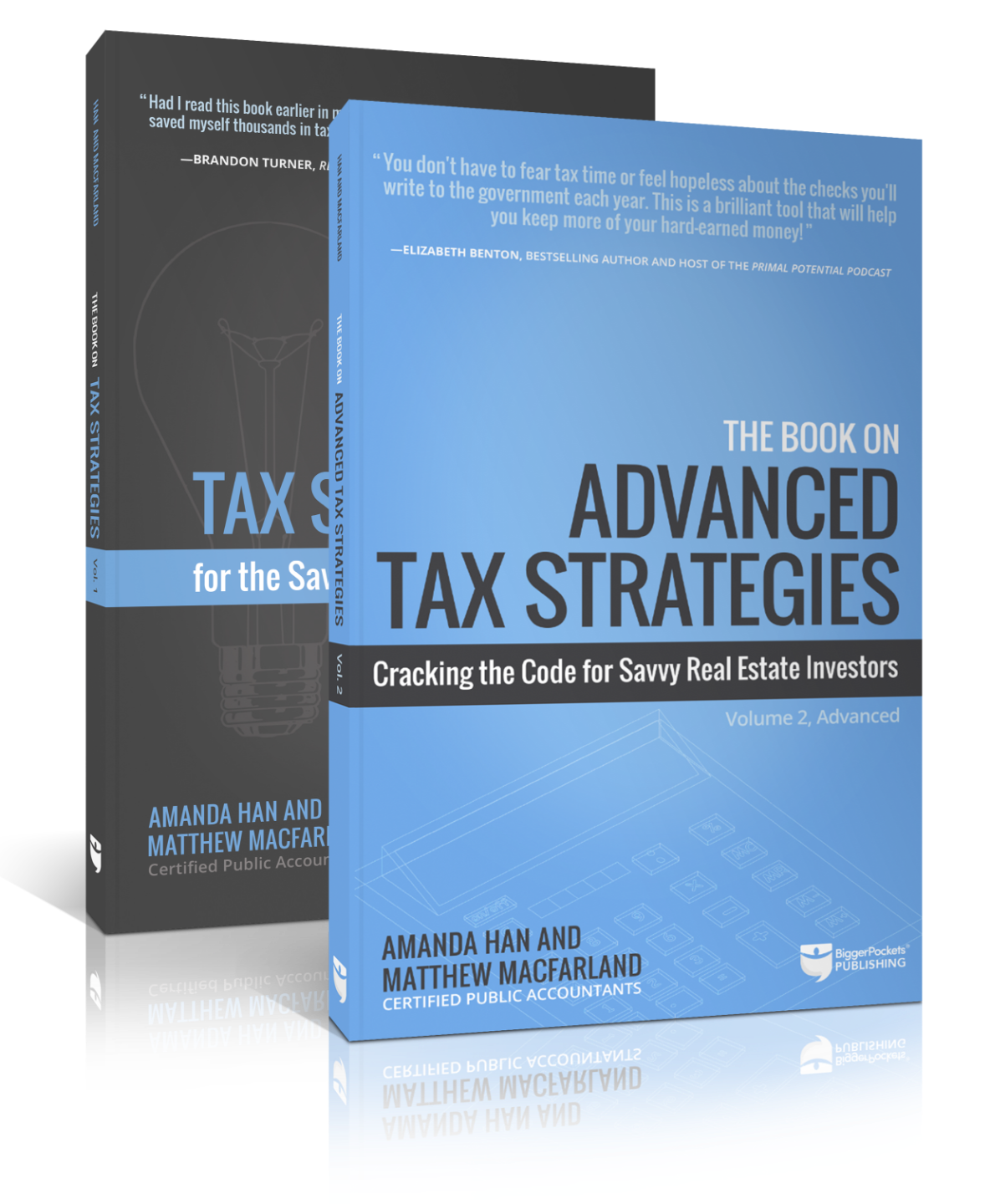
Our highly rated books are available now!
Order on Amazon, Biggerpockets and wherever books are sold.
Buy from Amazon

